When Death Stranding Embraced The Last of Us: A Fan Art So Deranged It Broke Reality
Death Stranding Last of Us crossover fan art fuses Joel into Sam Porter Bridges with a BB unit Ellie, a chillingly brilliant abomination.
In the hallowed annals of gaming history, there have been encounters so electric, so absolutely universe-shattering, that they rewrite the very fabric of what we consider to be possible. The year was 2021, and amidst the swirling chaos of next-gen anticipation, a single piece of fan art emerged from the digital ether like a phantom pregnancy pod—combining two of Sony's most divisive, soul-crushing, and monumentally successful narrative-driven titles. Death Stranding, with its lonely, urine-soaked courier trudging through a rain-drowned America, and The Last of Us Part 2, a tale of revenge so visceral it tore player communities apart, were suddenly no longer separate entities. They were fused. They were a single, screaming, beautiful abomination.
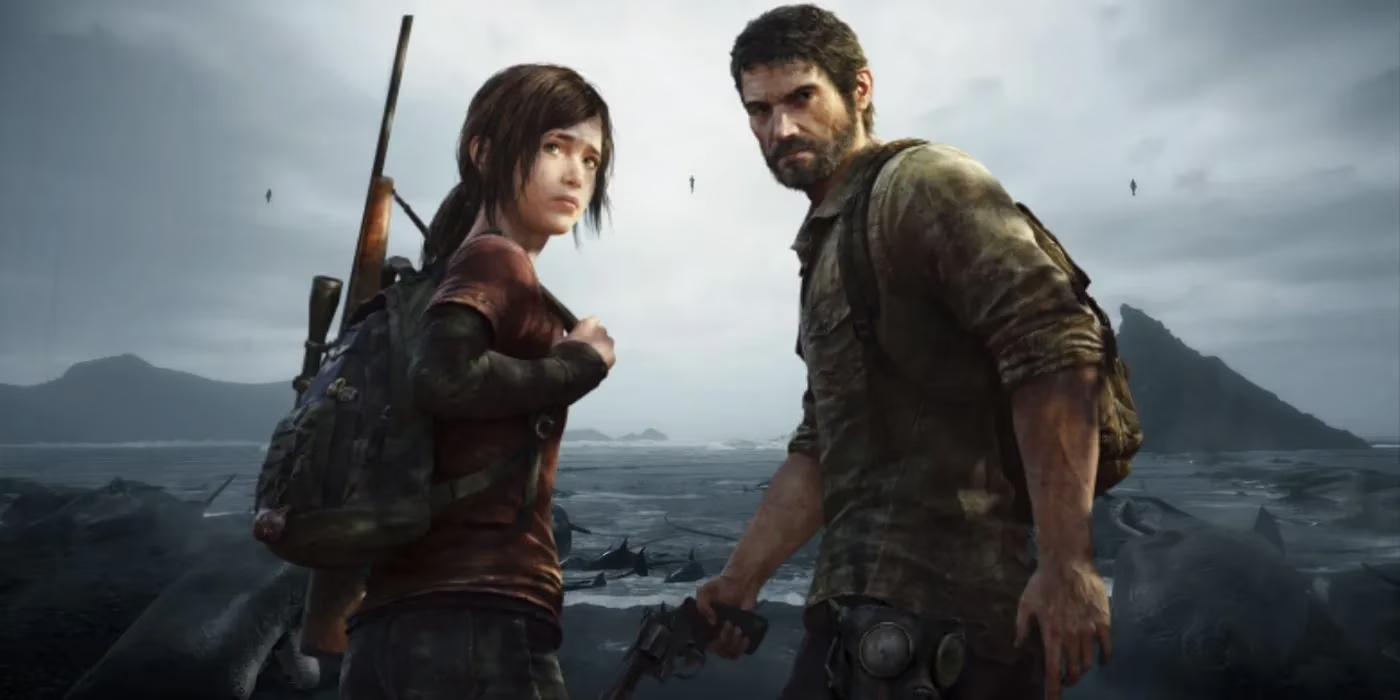
The mastermind behind this glorious atrocity, known only as Knutsdeez, did what no AAA developer dared. They took the grizzled, fatherly visage of Joel Miller—a man who had already endured the kind of loss that would turn ordinary mortals into dust—and stuffed him into the blue collar of Sam Porter Bridges. This was not a simple palette swap. Oh, no. This was a complete spiritual hijacking. Joel, now sporting a shock of distinguished grey hair that spoke of a million more sleepless nights, wore the protective raincoat meant to shield skin from the accursed timefall precipitation. He was no longer a smuggler of hope in a cordyceps-ravaged world; he was a repatriate, a man haunting his own timeline, delivering packages across a landscape woven from chiral nightmares. The sheer audacity of this visual marriage sent shockwaves through forums. Limbs were lost. Minds were melted.
But the true stroke of deranged genius lay not upon Joel’s shoulders, but within the translucent, womb-like pod of a Bridge Baby—the BB unit. In Death Stranding, this infant is the player’s living, breathing radar, a tiny life suspended in a synthetic amniotic fluid that connects the world of the living to the dead. It is a character so hauntingly vulnerable that players spend hours gently rocking the controller to soothe its cries. Knutsdeez, with a cackle that surely echoed through the halls of Valhalla, decided to give this BB the unmistakable auburn locks and defiant spirit of Ellie Williams. That’s right. Ellie, the foul-mouthed, clicker-slaying, tattoo-sporting firebrand, was now a literal fetus in a jar, helplessly gurgling while Joel trudged onward. The absurdity was so profound it bordered on the sublime. Fans collectively choked on their Monster Energy drinks. How could this be? Was Lou—the BB’s canonical nickname—not actually a clone of Sam Porter Bridges himself, a twist that redefines the entire narrative? Indeed, the lore explicitly reveals that Sam’s journey is a loop of self-discovery, his memories bleeding through the very being he carries. Making Lou into Ellie was, from a strictly canonical perspective, an impossibility, a paradox that would cause Kojima’s own doppelgänger to weep black tar. And yet, the artist simply shrugged, declaring they “wanted to include Ellie’s character somehow.” The sheer, unapologetic madness of it all was… chef’s kiss.
Consider, for a moment, the staggering thematic resonance that makes this unholy union not just plausible, but positively prophetic. Both Sam Porter Bridges and Joel Miller are men defined by their cargo. Sam carries physical packages—quantum data, old-world relics, a whole lot of metal—while Joel carries the weight of a surrogate daughter, a living MacGuffin who might just save the world if he doesn’t doom it first. They trudge. Oh, how they trudge. Through desolate, beautiful hellscapes. Sam balances stacks of supplies on his back, stumbling over rocks, a man whose very skeleton groans under the existential burden of reconnecting a shattered nation. Joel hoists ladders, scrapes together bullets, and hurls bricks at the fungal monsters that used to be his neighbors. Both exist in a perpetual state of protectorhood, a daddy-issue simulator cranked to eleven. The fan art, in its twisted brilliance, collapses these two archetypes into a single image: Joel-as-Sam carrying Ellie-as-BB. It is the ultimate paternal nightmare, a distillation of every anxiety about failing the one you love, rendered in stunning digital brushstrokes. Where Sam must soothe Lou to prevent autotoxemia—a lethal stress reaction—Joel must soothe Ellie’s rage, her survivor’s guilt, her desperate need for purpose. One cradles a pod, the other cradles a girl, but both know that one wrong step means absolute catastrophe.
The years have not dulled this image’s power. By 2026, the world has changed. Death Stranding: Director’s Cut, once a mere September 2021 release date glimmering on the horizon, has long since become a staple of the PS5 library, its enhanced cargo catapults and racetracks now the stuff of legend. And, in a cosmic joke that surely made Knutsdeez spit out their coffee, a full-fledged sequel is now either upon us or looming, promising true multiplayer connections—something the original’s strand system only teased. Hideo Kojima’s vision has expanded, embracing a network of players who can actually interact, not just share structures. In this new era, a fan art where the solitary Joel becomes the solitary Sam feels almost like a premonition, a glimpse into a multiverse where Sony’s first-party titans will eventually bleed into each other’s narratives. The BB pod is a chiral connection. The raincoat is a suit of armor against the grief that falls from the sky. The image remains a testament to the fact that gamers crave collisions, not just within genres, but within souls.
So let the purists scream into the void about canon inaccuracies. Let them cry that Lou is Sam and that a grown woman with a switchblade cannot possibly be a BB. They are missing the point entirely. This is what art does: it violates boundaries, it stitches together the incompatible, it forces you to stare unblinkingly at Joel’s weary face as he cradles a miniature Ellie in a fluid-filled tank, and it whispers, “Yes, this is the future of storytelling.” It is monstrous. It is ridiculous. It is absolutely, irrevocably perfect.