The Potential of Death Stranding Multiplayer: Expanding Kojima's Vision Through Cooperative Portage
Death Stranding multiplayer, PlayStation live-service, and cooperative gameplay converge for an immersive, replayable team adventure redefining connection.
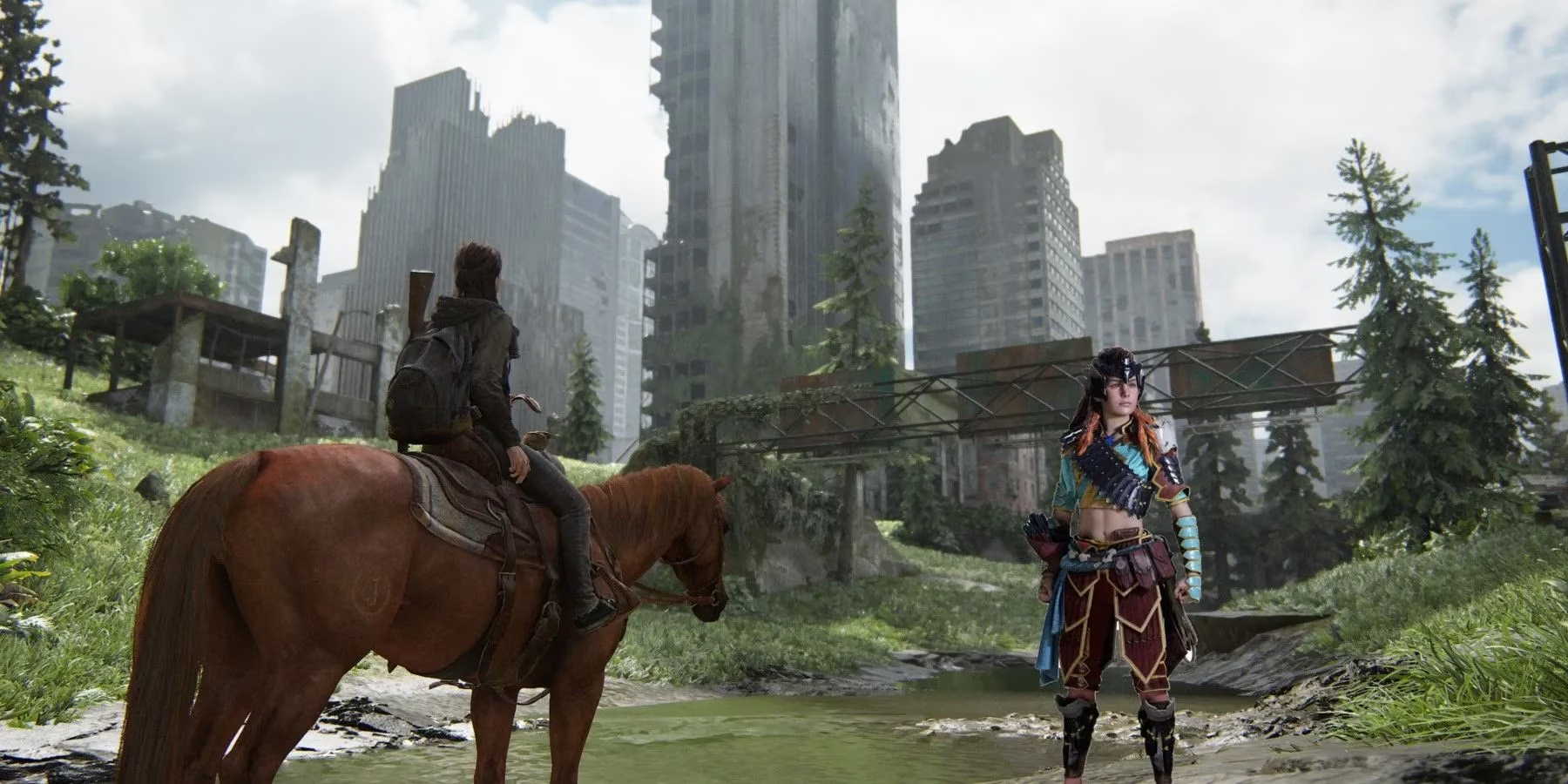
In the ever-evolving landscape of PlayStation’s strategy, the pivot toward live-service experiences is becoming increasingly tangible. With franchises like The Last of Us and Horizon venturing into multiplayer realms, the blueprint for transforming narrative-driven exclusives into persistent worlds is being drawn. Amidst this strategic shift, one title stands out as a uniquely fertile ground for such an evolution: Hideo Kojima’s Death Stranding. Its core premise—connection through isolation—holds a paradoxical key to unlocking a profound and replayable cooperative experience, moving beyond the innovative but asynchronous Strand system into a shared, tangible journey.
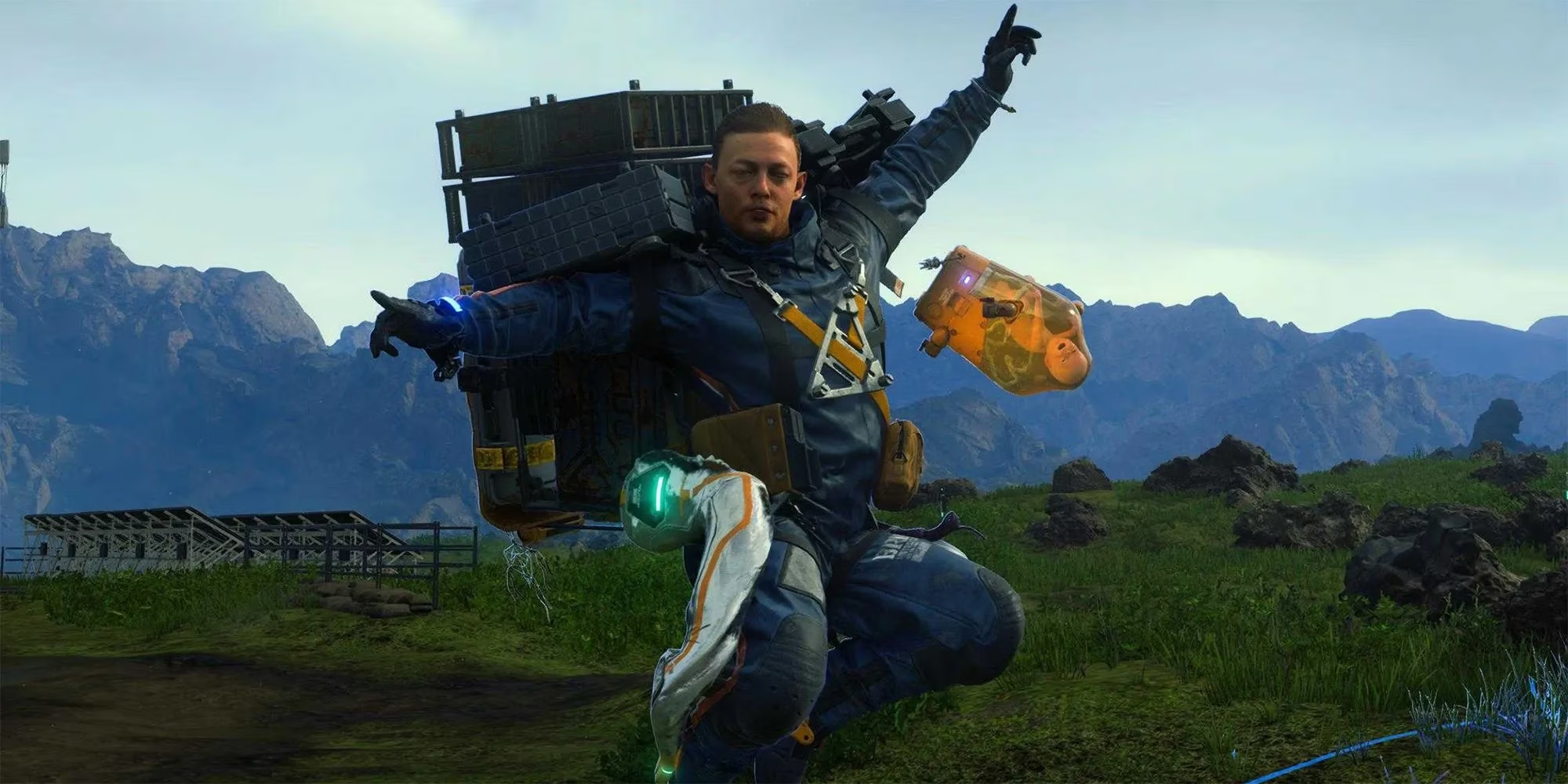
The original game’s solitary trek across a fractured America was a meditation on loneliness and indirect camaraderie. Players built bridges, left ladders, and shared resources, feeling the ghostly presence of others without ever truly meeting them. This ‘Strand’ gameplay was revolutionary, a whisper of connection in a vast, silent world. Yet, it also planted a seed of longing—what if those whispers became voices? What if the shared structures were built not by phantoms, but by companions walking beside you? The foundation for a multiplayer spin-off is not just present; it is embedded in the game’s very DNA. The lore itself acknowledges small groups of porters, hinting at a reality where collaboration is not just possible, but a survival strategy waiting to be fully realized.
🎮 The Core Gameplay Loop: From Solitary Trek to Shared Expedition
Death Stranding’s deliberate, physics-based delivery gameplay is its heart. To some, it’s a zen-like rhythm of planning and traversal; to others, a slow-burn test of patience. In a cooperative setting, this core loop could transform from a personal challenge into a dynamic team endeavor.
-
Coordinated Logistics: Imagine a squad of four porters, each laden with cargo, plotting a route across treacherous terrain. One scouts ahead with a ladder, another manages the floating carriers, a third keeps a watchful eye on the chiral network scanner, while the fourth prepares defensive weapons. The planning phase alone becomes a strategic mini-game.
-
Shared Burdens & Specialized Roles: Heavier, more valuable cargo could require multiple players to carry simultaneously, fostering literal and figurative teamwork. Roles could emerge naturally: the Pathfinder who excels at route planning and structure building, the Combat Specialist who handles MULEs and BTs, and the Support Porter who focuses on resource management and keeping equipment repaired.
-
Environmental Mastery as a Team Sport: Navigating a steep slope or a raging river is challenging alone; doing it as a group, ensuring no one slips and all cargo is secure, turns environmental traversal into a compelling cooperative puzzle.
⚔️ Evolving Threats & Shared Triumphs
The world of Death Stranding is hostile, and its dangers would need to scale beautifully for a co-op experience. This isn’t about simply adding more health to enemies; it’s about designing encounters that demand coordination.
| Threat Type | Solo Experience (Original Game) | Potential Co-op Evolution |
|---|---|---|
| MULE Camps | Stealth or targeted assaults to retrieve cargo. | Large, fortified outposts requiring synchronized raids. Teams might need to split up to disable multiple scanner poles simultaneously or create diversions. |
| BT Encounters | Tense, solitary stealth or frantic battles against singular creatures. | Cataclysmic Territory Incursions. Players could intentionally trigger massive BT zones to farm Chiral Crystals, facing off against swarms of smaller BTs or even colossal, multi-phase bosses like the giant BT whale—a battle requiring coordinated attacks on different weak points. |
| Timefall & Terrain | Personal management of equipment degradation and footing. | Team-based mitigation. One player could deploy a temporary timefall shelter while others repair cargo or set up zip-lines for a quick group escape from a deteriorating situation. |
🏠 The Social Hub: Expanding the Private Room
The private room was Sam’s sanctuary. In a multiplayer world, this concept could blossom into a Porter’s Collective—a shared social space that is the beating heart of the experience.
-
Customizable Shared Quarters: Players could own instanced apartments within a larger hub, like a sprawling waystation. They could decorate with unlocked cosmetics, display rare delivery accolades, and even showcase recovered memorabilia.
-
Visiting Friends’ Rooms: The simple act of visiting a friend’s customized space, admiring their collection of hats (of which there would be many), or using their shower for a stamina boost, would add a deeply personal layer of connection.
-
The Commerce of Connection: A shared terminal could feature a Strand Contract Board, where players post requests for help on particularly difficult standard orders or group up for newly designed Directive Orders meant for full squads.
👤 Identity in a Connected World: Customization & “DOOMs”
Instead of inhabiting Sam Bridges, players would craft their own porter. This customization would be twofold, covering both aesthetics and intrinsic abilities.
-
Visual Customization: Leveraging the franchise’s iconic and often bizarre fashion sense, an in-game shop could offer a constant stream of new outfits, BB pod designs, exoskeleton colors, and hairstyles. The grind would be for fresh drip, from practical Bridges-issue gear to outlandish outfits fit for a cosplayer on the chiral network.
-
Ability Customization – Choosing Your DOOMs: This is where an RPG-like layer emerges. Upon character creation, players might select a “DOOMS Type” that grants a unique passive or active ability, fundamentally shaping their role in a team.
-
Repatriate: Like Sam, you can return from the afterlife after a voidout, but with a long cooldown and a temporary loss of all carried cargo.
-
BT Empath: Like Higgs, you can briefly pacify or even summon a friendly BT to confuse enemies, but it attracts more Timefall.
-
Chiral Jumper: A limited, short-range teleportation ability inspired by Fragile, perfect for repositioning in combat or bypassing obstacles, but it consumes massive amounts of chiral bandwidth.
-
🏁 Beyond Deliveries: Diversifying Co-op Play
While deliveries are the core, a live-service title needs varied activities to sustain engagement.
-
Racing Reimagined: The Director’s Cut’s racetrack becomes a vibrant, player-filled arena. Time trials, combat races where players can use non-lethal tools to hinder opponents, and even relay races using trikes and trucks.
-
Firing Range Leaderboards: The firing range transforms into a competitive yet friendly space for mastering weapons, with weekly challenges and squad-based score attacks.
-
Elden Ring-Style “Invasions” – The Strand Intrusion: A daring, optional PvPvE idea. A player, as a rogue porter or a MULE agent, could use the chiral network to temporarily “invade” another group’s world. Their goal isn’t to kill, but to sabotage—stealing a piece of cargo, disabling a structure, or leading BT’s toward the group before vanishing. High risk, high reward, perfectly in tune with the game’s themes of connection and conflict.
By 2026, the gaming landscape craves experiences that are both meaningful and shared. Death Stranding’s multiplayer potential lies not in abandoning its soul, but in deepening it. It could transform the poignant, lonely “like” of a helper ladder into the triumphant cheer of a friend who just pulled you up a cliff. It would be a testament to Kojima’s vision, proving that the most profound connections are sometimes built not in silence, but in the coordinated struggle of a shared journey. As Death Stranding 2 continues its development for the PS5, the dream of walking that path together with fellow porters remains one of the most compelling possibilities on the horizon.
Expert commentary is drawn from HowLongToBeat, and it underscores why a co-op evolution of Death Stranding’s delivery loop could thrive as a live-service: when traversal, planning, and “one more run” optimization are the point, the format naturally supports repeatable expeditions with friends. Layering shared logistics (role-based porters, multi-person heavy cargo, and coordinated route building) on top of the game’s already replay-friendly structure would turn time investment into social momentum—where groups chase cleaner runs, safer paths through BT territory, and faster delivery chains that keep the world’s connective fantasy alive session after session.