Hideo Kojima's Departure Vision: Why Death Stranding 2 Could Perfectly Conclude His Saga
Hideo Kojima's Death Stranding 2 showcases unparalleled creative freedom, potentially marking his artistic farewell with a visionary, unrestrained masterpiece.
The gaming sphere buzzed when legendary auteur Hideo Kojima hinted that Death Stranding 2: On the Beach might conclude his directorial involvement with the franchise. During recent conversations, Kojima confirmed having conceptual blueprints for a third installment but firmly stated he wouldn't helm it. This revelation carries profound implications—Death Stranding 2 could serve as Kojima's intentional swan song, granting him the narrative closure he famously lacked during his Konami tenure. While some enthusiasts mourn the potential finale, others recognize a hidden blessing: creative liberation finally allowing Kojima to seal his surreal opus exactly as envisioned, untethered by corporate constraints.
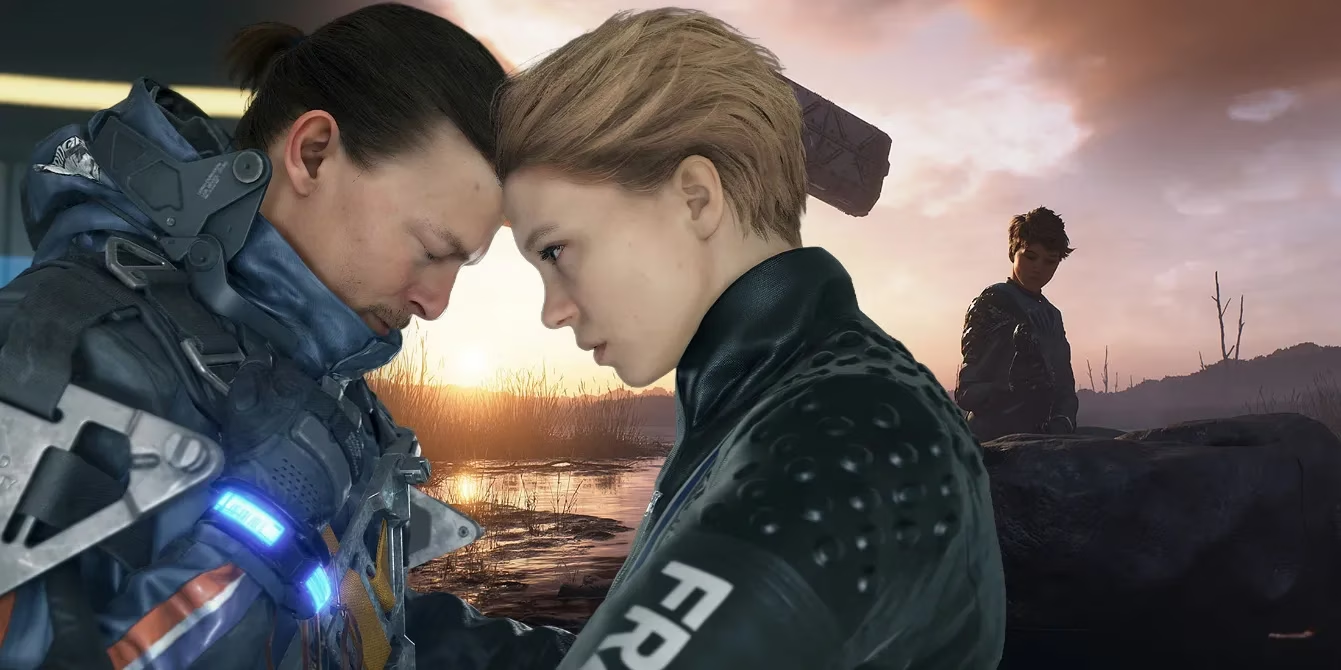
Kojima Productions' autonomy fundamentally transformed how the eccentric designer approaches storytelling. Remember the Konami era? Kojima's wildest concepts felt like caged beasts—brilliant yet restrained. Metal Gear Solid V: The Phantom Pain epitomized this struggle; its development collapsed under studio friction, forcing a fragmented release sans the intended 'Kingdom of the Flies' conclusion. Critics and devotees alike lamented its narrative gaps—a wound still palpable among stealth-action loyalists. Now, contrast that confinement with Death Stranding's unapologetic weirdness: infantile androids, spectral whales, and post-apocalyptic parcel deliveries. This is unfiltered Kojima, wielding absolute creative sovereignty.
Death Stranding 2 amplifies this artistic freedom exponentially. Early glimpses reveal:
-
😯 Biomechanical entities merging organic and synthetic horrors
-
🌊 Floating oceanic colonies defying physics
-
👶 Disturbing puppet-human hybrids
Each element radiates unrestrained imagination—precisely why Kojima cherishes this opportunity to culminate Sam Bridges' journey conclusively. Insiders suggest Death Stranding 2's finale will weave narrative threads so tightly that a third chapter feels unnecessary, redeeming Kojima's legacy after Metal Gear Solid V's abrupt truncation. It’s poetic justice: the visionary finally tying his own bow.
Yet ambiguity lingers. Kojima hasn't declared Death Stranding's universal end—merely his departure. The franchise could continue under new stewardship, inviting bold questions about authorship versus evolution. Consider these paradoxes:
| Konami Era Constraints | Kojima Productions Freedom |
|---|---|
| Narrative compromises enforced | Absolute creative control |
| MGSV's incomplete finale | DS2's planned narrative resolution |
| Corporate IP restrictions | Autonomous franchise ownership |
Will successors honor Kojima's thematic DNA—connectivity, loss, rebirth—or reinvent the IP entirely? The dilemma echoes Death Stranding's own themes: can something retain its essence when severed from its creator? Kojima’s exit may safeguard his artistic integrity, yet fans wonder if future iterations could become spiritual successors or hollow imitations. After all, Death Stranding thrives on idiosyncratic alchemy—social strand systems, melancholic optimism, tactile loneliness—that feels intrinsically Kojima-crafted.
As development advances toward release, one certainty emerges: Death Stranding 2 isn't just a sequel—it's Kojima’s hard-won redemption arc. He’s architecting a finale that honors his eccentric lexicon while freeing the franchise for potential metamorphosis. Perhaps relinquishing control is the ultimate act of creative confidence. But this invites a haunting uncertainty—when the creator departs his creation, what truly remains of its soul?