Death Stranding 2's Streamlined Approach Ensures More Players Finish the Journey, Says Kojima Productions
Death Stranding 2: On the Beach streamlines worldbuilding per Kojima, boosting accessibility; internal metrics show more players finishing it.
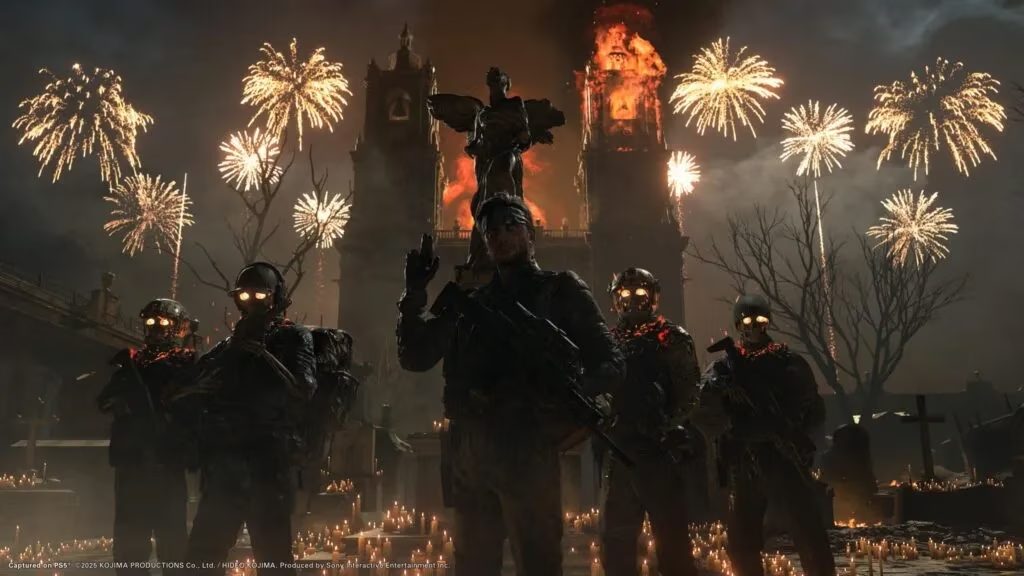
When Hideo Kojima set out to create Death Stranding 2: On the Beach, he had one clear mandate for his team: ensure that more players see the credits roll. It’s a deceptively simple goal, but for a studio known for its dense, often inscrutable narratives, achieving it required a fundamental rethinking of how the game introduces its world and story. In a recent interview, lead level designer Hiraoki Yoshiike peeled back the curtain on the design philosophy that shaped the sequel, revealing a deliberate shift away from the elaborate worldbuilding that defined – and sometimes bogged down – the original.
What was it about the first Death Stranding that made it so challenging for some to complete? Yoshiike points to the way new concepts and the post-apocalyptic setting were slowly unrolled. “We had to be very elaborate in introducing all the new concepts and what the world is like,” he explained. While that approach allowed for deep immersion, player feedback told a different story. For many, the pacing “might have been a little bit slow,” a hurdle that prevented them from experiencing the full emotional arc. It’s a dilemma many ambitious sequels face: how do you honor the complexity your fanbase loves while making the experience more welcoming to newcomers?
Kojima’s solution was characteristically direct. “Kojima wanted more people to enjoy the game all the way to the end. This was an order he provided,” Yoshiike stated. The resulting design shift wasn’t about dumbing down the plot, but about untangling it. The team intentionally pulled back on some of the exhaustive worldbuilding elements that characterized the first title. Instead of front-loading exposition, the narrative now pushes forward with a clearer, less meandering path. The game no longer demands that every player absorb every fragment of lore just to grasp the core stakes. Yet, this doesn’t mean the rich detail has vanished – far from it. Completionists are still rewarded with layers of hidden context, but they’re now optional treasures rather than mandatory pit stops.
This careful balancing act is already paying dividends. Yoshiike confirmed that internal metrics tell a compelling success story. “We’ve gotten a lot of feedback that it’s much easier to recommend DS2 to people. And we’re able to see the metrics, and we saw that people progress much further than they previously had. So that was just as we designed, I think.” The numbers back up the intention; more players are sticking with Sam Porter Bridges on his latest journey, crossing emotional and geographical divides that might have once stopped them cold. Have we finally reached an era where a Kojima game can be both deeply weird and widely accessible? The data suggests yes.
But streamlining the worldbuilding was only one piece of a larger, more daring puzzle. In a separate revelation last year, musician Yoann “Woodkid” Lemoine shared a startling anecdote about Kojima’s creative process. During development, early playtesting results came back overwhelmingly positive – and that was precisely the problem. Lemoine recounted, “He came to me and he said, ‘We have a problem… We have been testing the game with players and the results are too good. They like it too much. That means something is wrong; we have to change something.’” If that sounds counterintuitive, it’s because Kojima wasn’t chasing comfort. He wanted the game to be polarizing enough to trigger genuine, powerful emotions. So, crucial parts of the script were rewritten, and key moments were reshaped to inject the very discomfort that makes Death Stranding 2 so memorable. It’s a rare creator who will sabotage near-universal acclaim to chase a more impactful, divisive truth.
Since its initial PlayStation 5 launch in June 2025 to strong critical reception, Death Stranding 2: On the Beach has steadily expanded its reach. This month, the ambitious title finally arrived on PC thanks to a collaboration between Kojima Productions and support studio Nixxes. The port brings the haunting landscapes and social strand systems to an even larger audience, complete with the technical polish PC gamers expect. Early metrics show a fresh wave of players diving in, mirroring the launch-day rush the PS5 version enjoyed. The game’s ability to resonate across different platforms speaks to the maturity of its design – it invites players in without sacrificing its soul.
So, what does the future hold for a studio that learns so aggressively from player behavior? If Death Stranding 2 is any indication, Kojima Productions isn’t content to rest on its laurels. By listening carefully to why players left the first game unfinished, and by being brave enough to unsettle a comfortable narrative, they’ve crafted a sequel that feels both sharper and more emotionally generous. The result is a game that respects your time while still demanding your heart. And in an industry where completion rates are often a whispered afterthought, that’s a journey worth taking – right through to the very end.