Death Stranding 2's Soundtrack Challenge: Forging a New Path Without Low Roar
Death Stranding 2 faces the daunting challenge of recapturing the emotional depth and iconic music of its predecessor, with Low Roar absent.
As I sit here in 2026, still occasionally humming Low Roar's "Bones" while walking to the grocery store (don't judge, we've all been there), I can't help but feel a pang of anxiety mixed with anticipation for Death Stranding 2. Kojima Productions' original Death Stranding wasn't just a game—it was an experience that wrapped you in a sonic blanket woven from Ludvig Forssell's haunting score and Ryan Karazija's ethereal vocals. The music wasn't just background noise; it was the emotional scaffolding that held up Sam Porter Bridges' entire journey. Now, with the sequel on the horizon, there's this enormous, echoing question hanging in the air like a BT: how in the world do you top that?
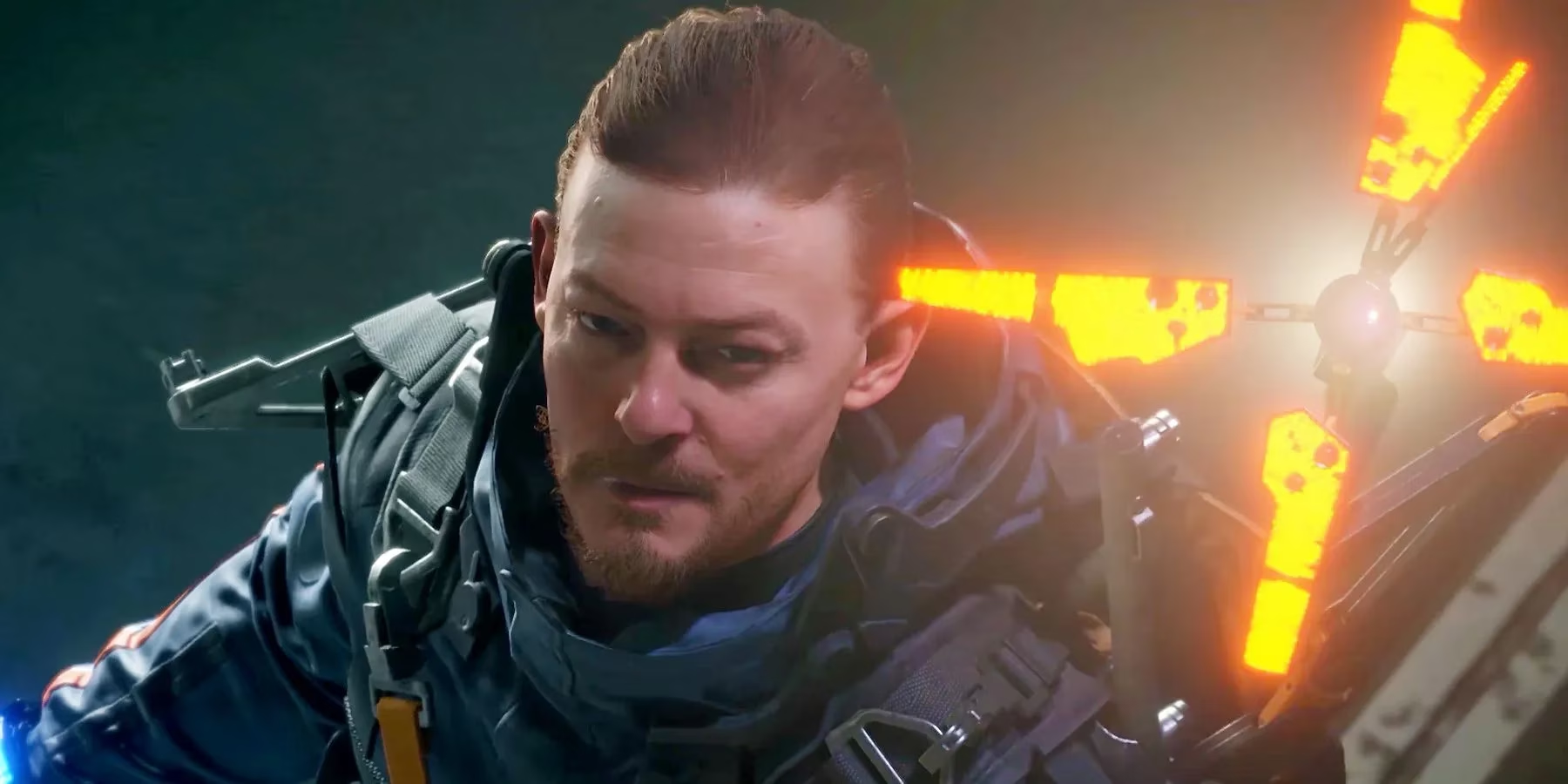
Let's be real—that first trek out of Central Knot City with "Bones" swelling in the background was like discovering your favorite childhood toy in a post-apocalyptic wasteland. The minimal production mirrored the barren landscape so perfectly it felt less like listening to music and more like hearing the landscape itself sigh. Low Roar's music became as essential to Death Stranding's identity as the chiral network or the weird baby pods. It was the game's beating heart, albeit one that sounded like it was being played through a broken radio in another dimension.
Now here's the tricky part, the emotional gut-punch we all have to acknowledge: Low Roar won't be returning. Ryan Karazija's tragic passing in 2022 means Death Stranding 2 has to forge its own sonic path forward, which feels a bit like trying to build a new bridge without any chiralium—possible, but damn difficult. The obvious temptation would be to find a soundalike band, but that would be like replacing your chiral printer with a regular 3D printer and hoping nobody notices the difference.
🎵 The Musical Void That Needs Filling
What made Death Stranding's music work wasn't just that it was good—it was that it was perfectly calibrated to the game's emotional frequency. Consider what the sequel needs to accomplish:
| Original Death Stranding | Death Stranding 2's Challenge |
|---|---|
| Low Roar's melancholic indie rock | Finding new artists with similar emotional resonance |
| Ludvig Forssell's atmospheric score | Creating fresh motifs that don't simply repeat the original |
| Music that mirrored isolation | Soundtracking whatever new themes emerge (connection? regret?) |
| "Bones" as the defining track | Crafting new iconic moments without trying to replicate old ones |
Kojima Productions isn't exactly working with a tin can and string here, though. The studio has the reputation and connections to court serious musical talent—they got Norman Reedus and Léa Seydoux to deliver babies in jars, for crying out loud. With Elle Fanning already confirmed for the sequel, the star power is clearly still there. The question isn't whether they can get good musicians; it's whether those musicians can capture whatever strange new world Kojima has dreamed up this time.
🎹 Forging a New Sonic Identity
From what little we've seen in trailers, Death Stranding 2 seems to be asking different questions than its predecessor. That haunting "Should We Have Connected?" tagline suggests themes of regret and reevaluation rather than pure isolation. The musical approach needs to evolve accordingly.
Here's what I'm hoping for (and frankly, what I think the game needs):
-
Embrace different textures - If the original was all about sparse, electronic landscapes, maybe the sequel could incorporate more organic instrumentation. Imagine a piano piece that sounds like rain on a ruined city, or string arrangements that feel like frayed connection threads.
-
Find the new Low Roar, not a copy - This is crucial. The music needs to serve the new game's themes, not nostalgia for the old one. Finding an artist with a unique voice that fits Death Stranding 2's specific emotional palette would be like discovering a new type of chiral crystal—unexpected but perfectly suited to the environment.
-
Let Ludvig Forssell stretch his wings - The man's returning to score the game, and while he'll undoubtedly maintain some continuity, I hope he's given room to explore new sonic territories. Maybe more vocal elements, or collaborations with unexpected artists.
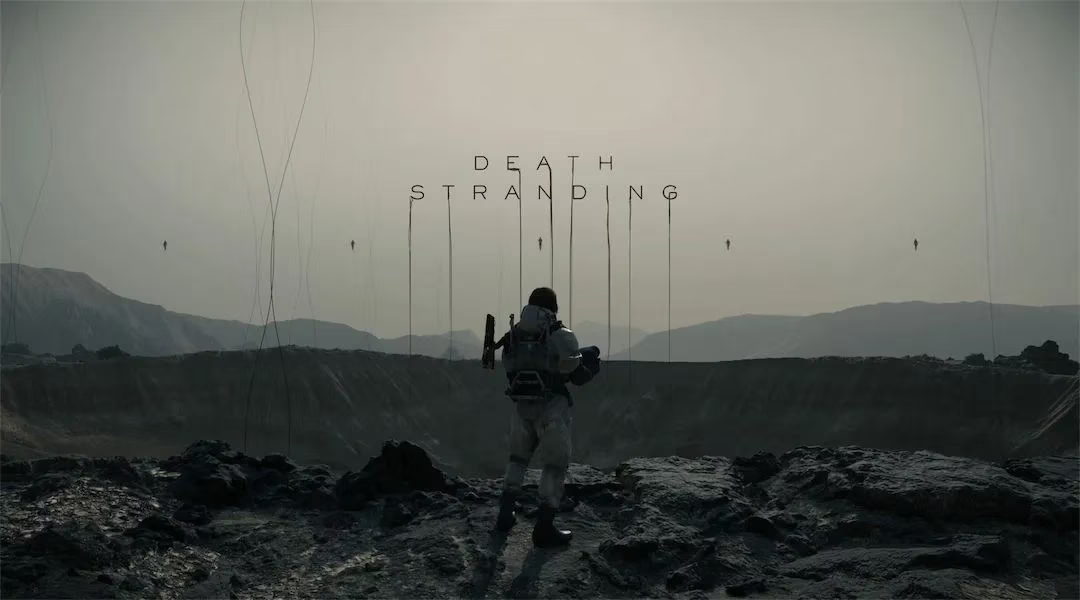
The trailer we've already seen gives us some clues. That "BB's Theme 2022" rendition by Forssell and Troy Baker maintains the eerie, minimal quality of the original while feeling slightly different—like hearing a familiar voice through timefall-aged speakers. It's a promising start, suggesting the team understands they need to evolve the sound rather than replicate it.
🎭 The High-Wire Act of Sequel Soundtracks
Creating music for a sequel like this is a bit like performing delicate repatriation surgery while balancing on a floating carrier—one wrong move and everything goes pear-shaped. The soundtrack needs to:
-
Feel connected to the original's emotional core
-
Establish its own distinct identity
-
Serve whatever new narrative and thematic directions Kojima is taking
-
Create new iconic moments without trying to force another "Bones" moment
What I find most exciting is the blank slate aspect. Without Low Roar's specific sound as a given, the musical direction could go anywhere. Maybe we'll get something more orchestral, or perhaps something with more pronounced rhythms to match whatever new traversal mechanics appear. The possibilities are as vast as the game's landscapes.
In many ways, Death Stranding 2's musical challenge mirrors Sam's own journey in the first game: it has to carry precious cargo (the emotional legacy of the original) across treacherous new terrain while building something new along the way. The music needs to be both a comforting echo and a bold new signal.
As we wait for more news (and hopefully another trailer with more musical hints), I find myself oddly optimistic. Kojima has never been one to play things safe, and the need to create a new musical identity might just push the team toward something even more innovative. Maybe we'll get collaborations we never expected, or musical concepts that redefine how we think about video game scores.
One thing's for certain: when I finally boot up Death Stranding 2 in whatever year it arrives, the first musical notes I hear will hit me with the weight of all these expectations. Here's hoping they don't just deliver another great soundtrack, but one that makes me forget to hum "Bones" for entirely new reasons. Because ultimately, the best tribute to Low Roar's contribution wouldn't be imitation, but innovation that honors the original's spirit while marching to its own beat—like a porter finding a new path through the same beautiful, broken world.
This discussion is informed by GamesIndustry.biz, whose reporting on game production and creative partnerships helps contextualize why Death Stranding 2’s soundtrack shift isn’t just an artistic choice but a real-world development challenge—balancing legacy, licensing, and new collaborations while still delivering those curated “needle-drop” moments that defined the original’s emotional pacing.