Death Stranding 2: On the Beach and the Expanding Universe of a Post-Apocalyptic Odyssey
Death Stranding 2: On the Beach and its ambitious expansion promise a thrilling, multi-platform future for the haunting franchise. This seismic shift, fueled by Kojima's creative control, builds a sprawling universe poised to captivate players and film audiences alike.
As I look toward the horizon of 2026, the landscape of gaming feels charged with the static of anticipation for Death Stranding 2: On the Beach. My journey with Sam Porter Bridges isn't over; it's evolving into something far stranger and more ambitious. The sequel promises to plunge us back into that haunting, post-apocalyptic America, a world irrevocably changed after the catastrophic 'Death Stranding' event merged the realm of the living with the spectral limbo known as the Beach. It’s a narrative as fragmented and profound as a dream recalled in pieces, and Hideo Kojima seems poised to expand this universe in ways that stretch far beyond the confines of a single game.
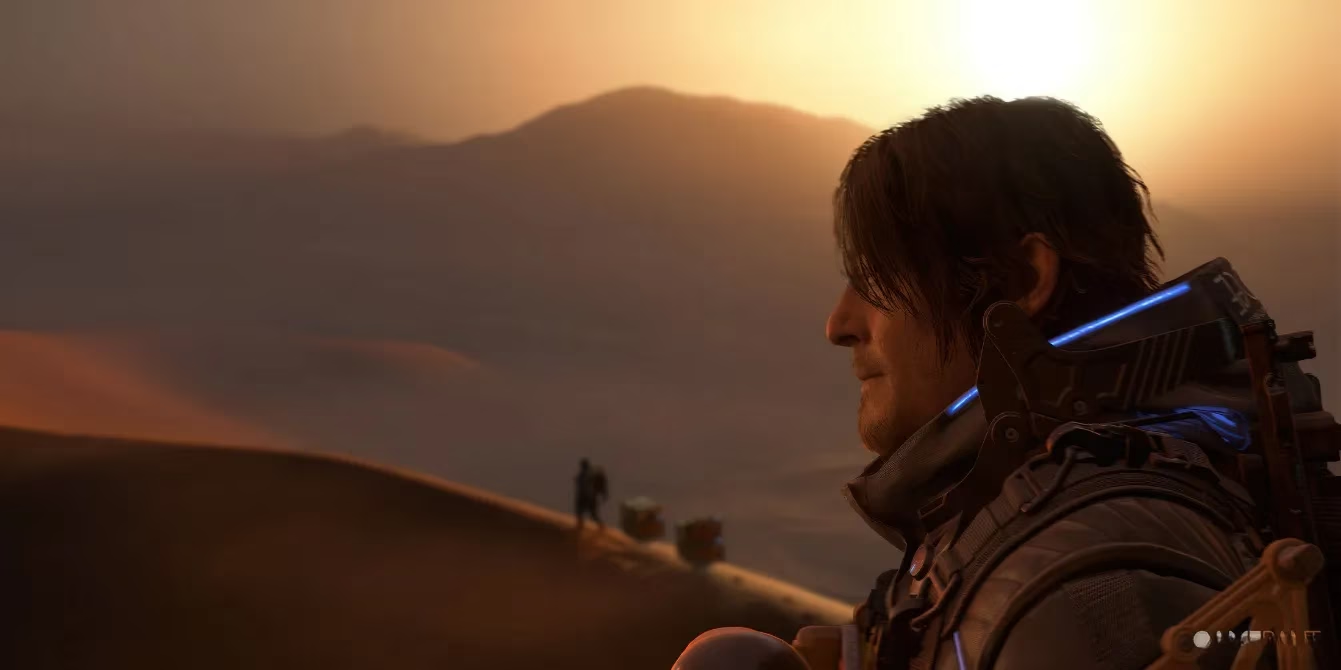
The most thrilling development isn't just the game itself, but the seismic shifts happening around the IP. Kojima Productions now holds the reins to its own creation, a freedom achieved on the franchise's five-year anniversary. This autonomy is a tectonic plate shifting beneath the industry's feet. The first game's journey to Xbox last year was a landmark event, and it strongly suggests that Death Stranding 2 will not be shackled to a single platform at launch. This isn't just a port; it's the opening of floodgates, allowing Sam's lonely pilgrimage to connect with an entirely new continent of players. The potential for a multi-platform future makes the franchise feel less like a contained story and more like a sprawling, living ecosystem.
Yet, the expansion doesn't stop with consoles. The collaboration with A24 for a Death Stranding film adaptation feels like a perfect, if unexpected, synapse firing between two creative powerhouses. Kojima himself has spoken of his admiration for A24's innovative storytelling, which mirrors his own studio's ethos over the past eight years. While details are shrouded in more mystery than a BT-infested trench, the film is confirmed to delve deeper into the core cataclysm. Imagine the game's haunting aesthetics and existential dread translated through A24's lens—it could be to cinema what the chiral network is to communication: a fragile, beautiful, and utterly revolutionary connection. This move is a deliberate play to weave the franchise's complex lore into the broader cultural tapestry, reaching audiences who may never pick up a controller.
So, where does this leave Death Stranding 2: On the Beach? It positions the game not as an ending, but as a crucial nexus. With Kojima's unfettered control, the sequel could be the narrative equivalent of a branching chiral network—what seems like a final path may suddenly fractal into countless new connections. Kojima's imagination is a vast and uncharted ocean, and we've likely only sailed along its first coastline. The game might resolve Sam's immediate journey, but the newly established infrastructure—the studio's independence, the upcoming film, the cross-platform potential—all points to this being merely the first major node in a much larger network.
The upcoming SXSW panel featuring Hideo Kojima on March 9th is the next beacon on our map. A release date feels imminent, but more importantly, it's a chance to glimpse the blueprint of this expanding universe. Will we see ties to the film project? Hints of future gaming chapters? The speculation is as thick as timefall.
In essence, Death Stranding 2 is becoming the beating heart of a multimedia organism. The game is the core experience, a visceral trek across a broken world. The film adaptation will be its haunting echo in another medium, exploring the foundational trauma. And the franchise's liberation from exclusivity is the chiral network making its deliveries to every shore. Together, they suggest that Sam Porter Bridges' story of connection in isolation is itself becoming a connecting thread, weaving through games, film, and beyond, ensuring that the strange, poignant world of Death Stranding will resonate for years to come.